
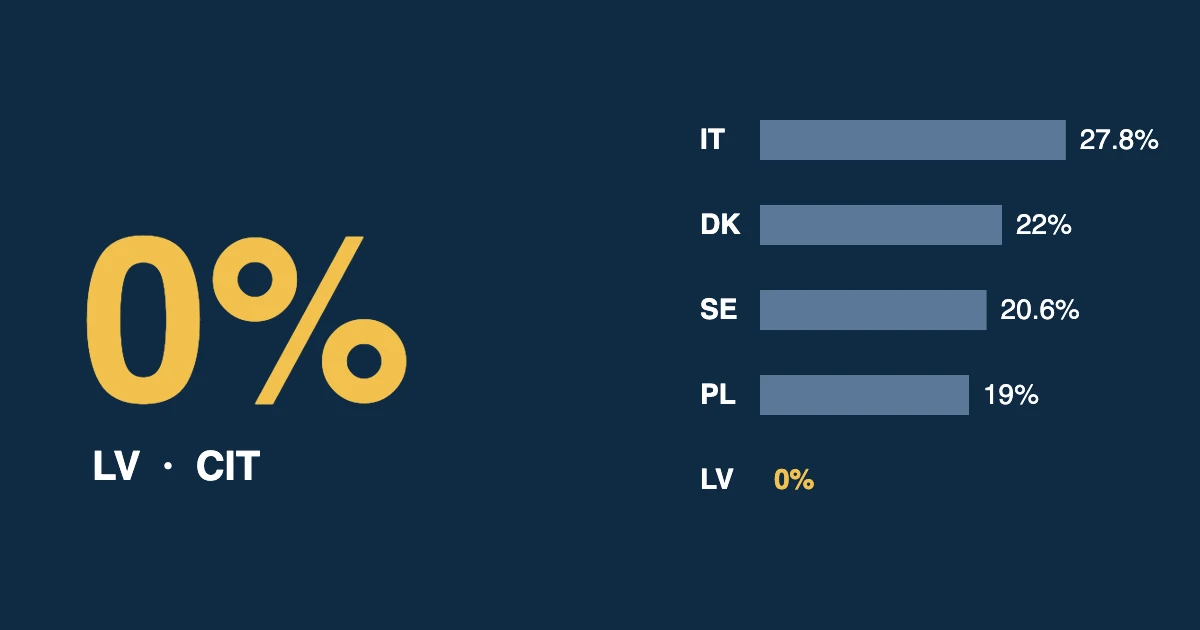
Reinvested profit in Latvia is taxed at 0%. Most European companies pay corporate income tax on their profit every year, whether the money leaves the business or not. In Latvia, a company that keeps its profit and puts it back into the business pays nothing. Tax becomes due only when profit is paid out as dividends or treated as distributed.
This is not a loophole or a special incentive you have to apply for. It is the standard Latvian corporate tax model, in force since 2018 and available to every Latvian company. Below we explain how it works, what it means for last year’s profit, and how it compares with Italy, Poland, Sweden and Denmark, with charts and independent data.
Table of Contents
How the 0% tax on reinvested profit works
Latvia taxes distribution, not profit. As long as profit stays in the company, there is nothing to pay. The money can be used for equipment, property, stock, hiring, acquisitions or simply kept as a reserve.
- Retained and reinvested profit: 0% corporate income tax, with no time limit.
- Distributed profit (standard regime): 20% of the gross amount. In practice the net dividend is divided by 0.8, so a net dividend of EUR 80,000 means EUR 20,000 of tax.
- Dividends received by individuals: under the standard regime no further personal income tax is due in Latvia, so the total Latvian burden on a payout stays at 20%.
- New optional regime from 2026: companies owned only by individuals can choose 15% corporate income tax on distribution plus 6% personal income tax withheld from the dividend. The total is about the same (around 20%), but the 6% is a personal tax that a foreign shareholder can often credit at home. The change was adopted by the Saeima in December 2025.
The Tax Foundation describes this design as a cash-flow tax: because tax is deferred until distribution, it works like an immediate write-off for every investment the company makes.
Reinvested profit: what last year’s profit is worth in each country
Take a company that earned EUR 100,000 last year and wants to put all of it back into the business. In most EU countries, part of that money goes to the tax authority before a single euro is reinvested. In Latvia, the full amount stays in the company.
| Country | Corporate tax rate (2026) | Tax on EUR 100,000 retained profit | Left to reinvest |
|---|---|---|---|
| Latvia | 0% on reinvested profit | EUR 0 | EUR 100,000 |
| Poland (standard CIT) | 19% (9% for small taxpayers) | EUR 19,000 | EUR 81,000 |
| Sweden | 20.6% | EUR 20,600 | EUR 79,400 |
| Denmark | 22% | EUR 22,000 | EUR 78,000 |
| Italy | 27.8% (24% IRES plus regional IRAP) | EUR 27,800 | EUR 72,200 |
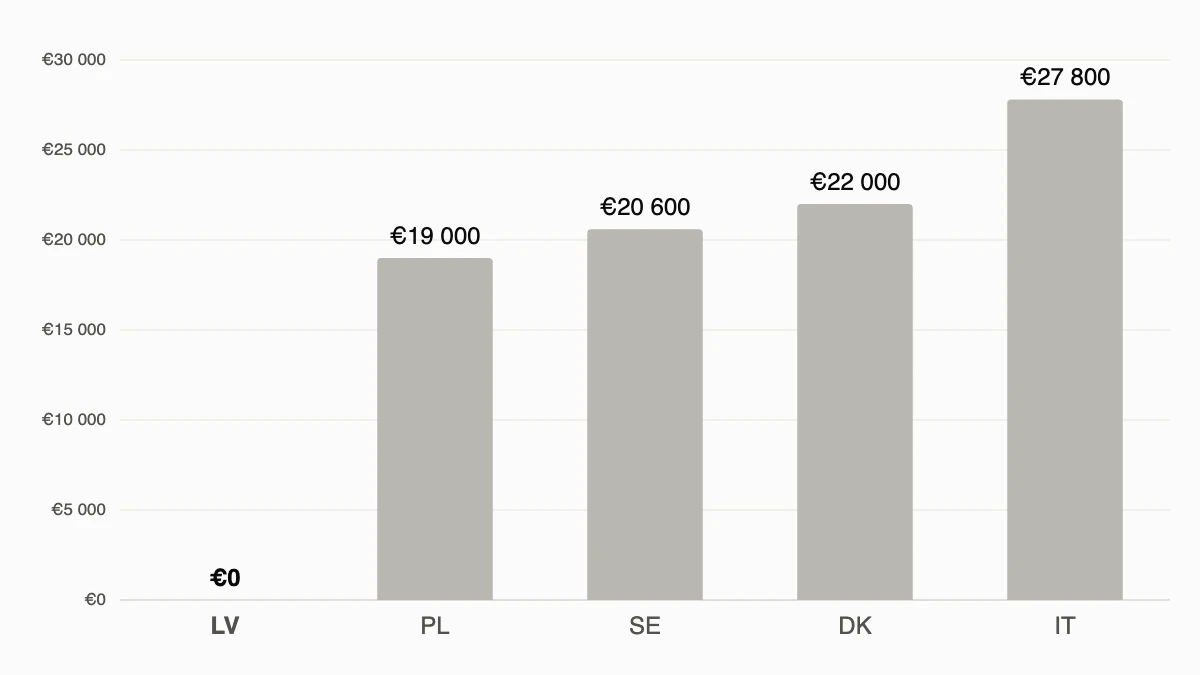
The difference is EUR 19,000 to EUR 27,800 a year for every EUR 100,000 of profit. Italy’s figure uses the combined statutory rate published by the Tax Foundation; IRAP is calculated on a different base, so the exact amount varies by company.
10-year scenario: how reinvested profit compounds
The real advantage appears over time. Money that is not paid in tax keeps working inside the business. To show the effect, we modelled a simple case.
- The company earns EUR 100,000 of profit every year for 10 years.
- Everything left after corporate tax is reinvested.
- The reinvested capital earns an 8% annual return, which is taxed each year in Poland and Italy but not in Latvia while it stays in the company.
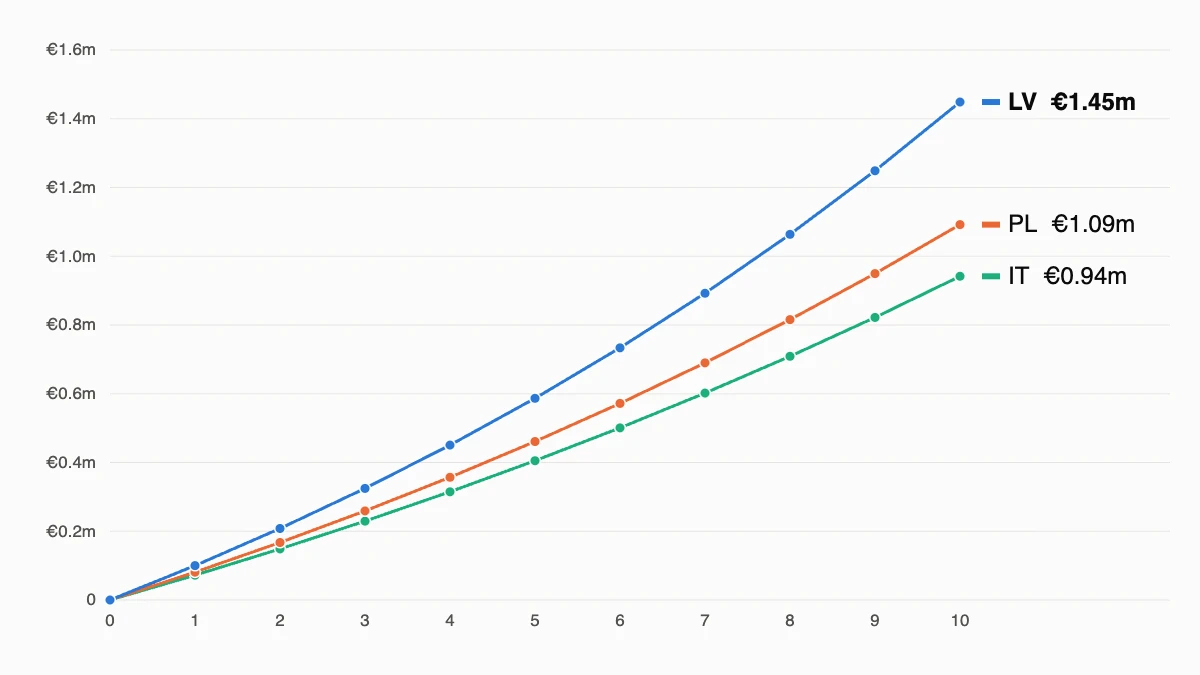
After 10 years, the Latvian company has built about EUR 1.45 million of capital. The same business in Poland would have about EUR 1.09 million, and in Italy about EUR 0.94 million. That is EUR 357,000 more than in Poland and EUR 507,000 more than in Italy, from exactly the same operating results.
The model is simplified. Real returns, depreciation and local reliefs will change the numbers. The direction, however, does not change: deferring tax on reinvested profit lets capital compound faster.
What if the profit is paid out?
Deferral is only part of the story. Even when profit is distributed, the total tax burden in Latvia is lower than in most of Europe. The table shows the combined corporate and personal tax on EUR 100,000 of profit paid out in full to a resident individual shareholder at the top rate.
| Country | Corporate tax | Personal tax on dividends | Total tax burden |
|---|---|---|---|
| Latvia (standard) | 20% | 0% | 20% |
| Latvia (optional 2026 regime) | 15% | 6% | about 20.1% |
| Poland (standard CIT) | 19% | 19% | 34.39% |
| Poland (Estonian CIT) | 10% or 20% on payout | 19% less a credit | 20% or 25% |
| Sweden | 20.6% | 30% (20% within 3:12 limits) | 44.42% (36.48%) |
| Italy | 27.8% | 26% | 46.57% |
| Denmark | 22% | 42% (27% on the lower band) | 54.76% (43.06%) |
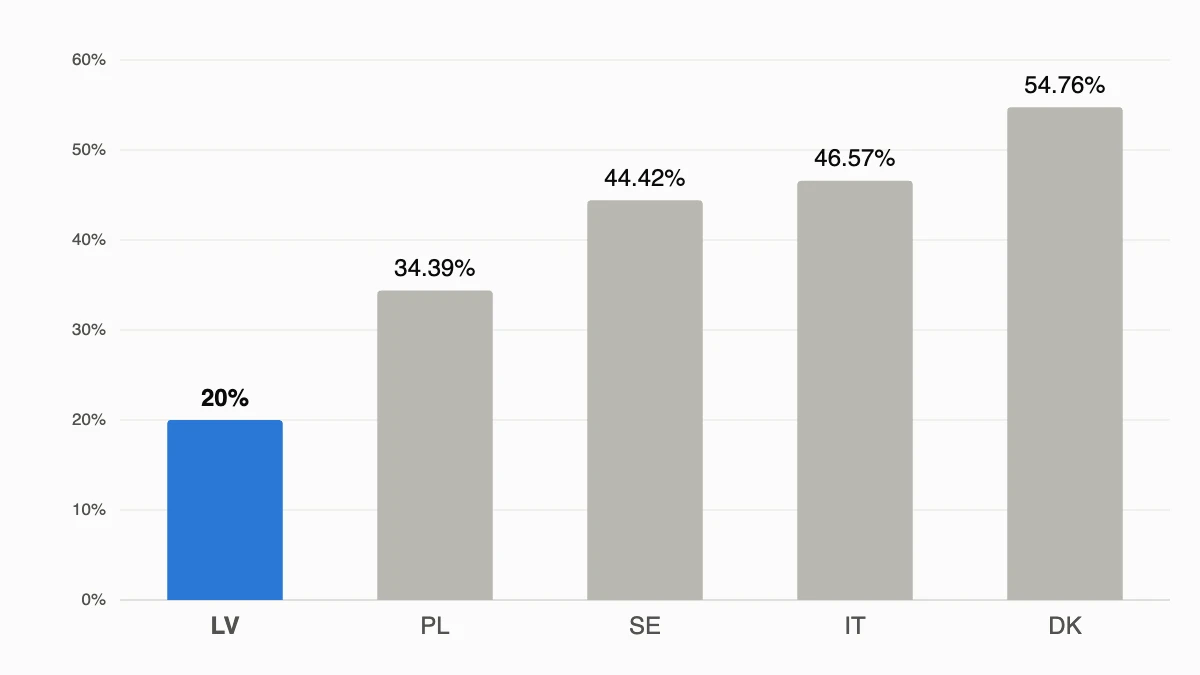
A few notes. Poland has its own version of the Latvian and Estonian model, known as Estonian CIT, but it comes with conditions: at least three employees, a limit on passive income, restrictions on shareholdings and a four-year commitment. Italy offered a reduced 20% IRES rate for 2025 profits tied to reinvestment and new hiring, but it was a temporary, conditional measure rather than a standing regime.
Sweden’s new 3:12 rules for closely held companies, in force from 2026, allow 20% tax on dividends up to a threshold. Denmark taxes share income at 27% up to an annual indexed threshold and 42% above it.
Reinvested profit in numbers: what the data says
Independent rankings and research back up the comparison above.
- Number 1 for corporate tax. In the Tax Foundation’s 2025 International Tax Competitiveness Index, Latvia ranks 1st among OECD countries for corporate taxation and 2nd overall, behind only Estonia. Sweden ranks 11th overall, Denmark 27th, Poland 35th and Italy 37th.
- Below the European average. The average statutory corporate tax rate in Europe is 21.6% in 2026. Latvia’s 20% applies only on distribution, and reinvested profit is taxed at 0%.
- No second layer on dividends. According to the Tax Foundation’s dividend tax data, the average top dividend tax rate across 35 European countries is 20.82%. Latvia’s personal rate under the standard regime is 0%, while Denmark’s is 42%.
- Evidence from Estonia. Estonia introduced the same model in 2000. An Eesti Pank working paper (Masso, Meriküll and Vahter, 2011) found that Estonian firms afterwards held more retained earnings (about 11 percentage points more relative to total assets), relied less on debt and kept more cash. Firms with more liquidity were also more likely to survive the 2008 crisis.
- Tax revenue has not collapsed. Eurostat data cited in a 2025 academic study show Latvia’s corporate income tax revenue rising from about EUR 163 million in 2018 to about EUR 542 million in 2023, as companies grew and distributed more over time.
What counts as distributed profit in Latvia
The 0% rate applies to genuinely reinvested profit. Latvian law treats certain payments as deemed distributions and taxes them at 20% even if no dividend is declared. The most common are:
- expenses not related to the business, including personal expenses of owners;
- loans to related parties, unless specific conditions are met;
- transactions with related parties at non-market prices (transfer pricing adjustments);
- bad and doubtful debts written off without meeting the legal conditions;
- interest above the thin capitalisation limits;
- representation costs and donations above the permitted limits.
In other words, the model rewards companies that actually invest. Taking money out of the company through other channels is taxed as if it were a dividend.
Is the 0% tax on reinvested profit legal for foreign owners?
Yes. The regime applies to any company registered and taxable in Latvia, regardless of who owns it. What matters is substance. A Latvian company should have real activity and management in Latvia.
Shareholders resident in Italy, Poland, Sweden, Denmark or elsewhere should also check their home country’s controlled foreign company (CFC) rules and the double tax treaty with Latvia. Their own country may tax them on dividends or, in some cases, on undistributed profit of a low-taxed foreign company. Before starting any cooperation, it is also worth running the standard sanctions and counterparty checks.
Done properly, a Latvian company is a legitimate and transparent way to build up capital: reinvested profit is not taxed, and tax is paid when the owner decides to take money out. Read more about why companies and investors choose Latvia as a base for growth.
Frequently asked questions
Is reinvested profit in Latvia really taxed at 0%?
Yes. Corporate income tax in Latvia applies only to distributed and deemed distributed profit. Reinvested profit kept in the company is not taxed, with no time limit.
What tax applies when dividends are paid?
Under the standard regime, 20% of the gross profit distributed (net dividend divided by 0.8). Individuals pay no further personal income tax on these dividends in Latvia. From 2026, companies owned only by individuals can choose 15% corporate tax plus 6% personal income tax instead.
How much more capital can a company build with tax-free reinvested profit?
In our 10-year model with EUR 100,000 of annual profit and an 8% return, a Latvian company builds about EUR 1.45 million, compared with about EUR 1.09 million in Poland and EUR 0.94 million in Italy.
Can a foreign company or individual own a Latvian company and use this regime?
Yes. The regime does not depend on the owner’s nationality or residence. However, real economic substance in Latvia is essential, and the owner’s home country rules on CFCs and dividends must be checked.
Does Poland have a similar regime?
Yes, Estonian CIT (ryczałt od dochodów spółek). It also defers tax until distribution, but only for companies that meet employment, income and ownership conditions.
This article is for general information and is not tax advice. Rates are as of October 2026 and may change. RR Law and Finance can assess your situation and help you set up or restructure a company in Latvia. Contact us for a consultation.